.avif)

Outsourcing to Bangladesh vs India: Where Each One Wins
We build software in Dhaka, so we sourced every number here, including the two where Bangladesh loses to India. A comparison you can check yourself.
The question that decides most of our first calls arrives about twenty minutes in, once the technical part is out of the way, and it almost always arrives apologetically. "We are also speaking to a couple of teams in India. Why Bangladesh?"
For a long time I gave a bad answer to it. I would talk about our engineers, our process, our delivery record, and I would watch the other person politely wait for me to finish. Well, of course they were waiting. They had not asked me to sell them anything. They had asked a genuine question about outsourcing to two different countries, and I was answering a different one.
So I have finally sat down to answer the actual question. I run a software firm in Dhaka, which means I am not a neutral party, and I am going to be upfront about the places where the honest answer is "India, and it is not close."
How we compared the two
Firstly, the conflict of interest. We are a Bangladeshi engineering firm and we would like you to hire us, so you should not take our word for anything on this page that is not attributed to someone else. Every country-level claim below carries its source inline, and where the source is our own work, we say so.
The criteria were fixed before the research, in order to avoid the usual trick of picking measures after seeing which ones flatter you —
- English proficiency
- Talent pool depth and industry scale
- Cost
- Time-zone overlap
- Engagement continuity, meaning who is still on your account in year three
- What actually goes wrong
One more ground rule. Where a figure exists from a primary source, we use the primary source. While researching this piece we found a widely-syndicated site reporting India's 2024 GNI per capita as $2,650 when the World Bank's own database says $2,550. That is a small error, but it is the kind of small error that gets copied from page to page in this category until nobody can trace it.
Why do companies outsource to Bangladesh?
Cost is the usual reason, and the industry is real rather than notional. Bangladesh exported $724.6 million of ICT services in the 2024-25 financial year, growing 7.7% year on year, according to the Export Promotion Bureau.
The direction of travel is the more interesting number. Those exports grew 7.7% year on year, and 13.5% in the first five months of the current financial year. India's technology exports grew 4.6% over the comparable period. So Bangladesh is growing faster than India, from a base that is, as a later section shows without flinching, roughly three hundred times smaller. Both halves of that sentence are true and most pages on this topic print only the first.
Those are the honest headline numbers. The better reasons, in our experience, are the ones buyers discover after they arrive rather than the one that brought them: a mid-sized firm here will give a mid-sized client the attention of its senior people, and the team you meet in the sales call is usually the team that shows up on Monday. Neither of those is a national characteristic. Both are questions you should ask any vendor in any country, and we come back to them further down.
Is Bangladesh cheaper than India, and by how much?
Yes, Bangladesh is less expensive, and we are not going to quote you a rate. The two figures circulating most widely on this exact question are a tidy hourly range and a tidy percentage discount, and both appear on pages that cite no source for either.
We looked. There is no credible, published, Bangladesh-sourced engineering rate benchmark. Glassdoor currently reports an average Bangladeshi developer rate that is wrong by roughly two orders of magnitude, which tells you how thin the underlying data is. So any firm quoting you a tidy national rate range is quoting you its own price list with a flag on it.
What we will say is this. The gap is real and it is large enough to matter to your budget, it varies enormously by seniority and engagement shape, and it is the least interesting thing about this decision. A rate that is 40% lower on a project that has to be rebuilt is not a saving.
Which country is best for outsourcing?
Neither, and the honest answer depends on one variable more than any other: the size and shape of the team you need. If you are staffing 50-plus engineers on a common stack, India is the better answer almost every time.
If you are a company of moderate size who wants senior attention, continuity, and a vendor for whom you are a significant account rather than the twelfth priority, that case is much more even, and it is the case where we would argue for Bangladesh. There is a full decision table further down this page.
Is Bangladesh more developed than India?
This is one of the most-asked questions on this topic and the answer surprises most people, including a fair number of Bangladeshis. On GNI per capita, the World Bank's 2024 figures put Bangladesh at $2,820 and India at $2,550 (Atlas method), so on that particular measure Bangladesh is slightly ahead.
We are including this because it is asked, not because it is useful. National development statistics tell you very little about whether a specific firm can deliver your specific system, and the two countries are close enough on this measure that anyone leaning on it is reaching. Please do not choose a vendor on a per-capita income table. The measure that actually matters is industry scale, and there the picture is not close at all, as the next section shows.
What are the downsides of outsourcing to India?
The honest answer is that the one everybody cites has largely gone away. Attrition at the top Indian IT services firms ran at roughly 23% at its FY2022-23 peak and has since fallen to around 13% in FY2025, with the sector expecting it to hold in the 13-15% band.
So "Indian teams churn" is a claim we could have made two years ago and cannot make honestly today. We are pointing this out partly because it would have been an easy line to write, and you should be suspicious of any Bangladeshi vendor still writing it.
The real downside of a large Indian vendor is not turnover. It is position in the queue. A tier-one firm assigns its strongest people to its largest accounts, which is a rational thing for it to do and a bad thing for you if you are not one of those accounts. The second is pyramid staffing, where the senior engineers you met during the sale are spread thinly across many projects and the day-to-day work sits with much more junior people than you were expecting. Both are structural consequences of scale rather than failures of character, and both are worth asking about directly.
What are the downsides of outsourcing to Bangladesh?
There are three, and the first one is the one our industry keeps quiet about. India's technology exports were $224.4 billion in FY2025 against Bangladesh's $724.6 million, which is a gap of roughly 300 times.
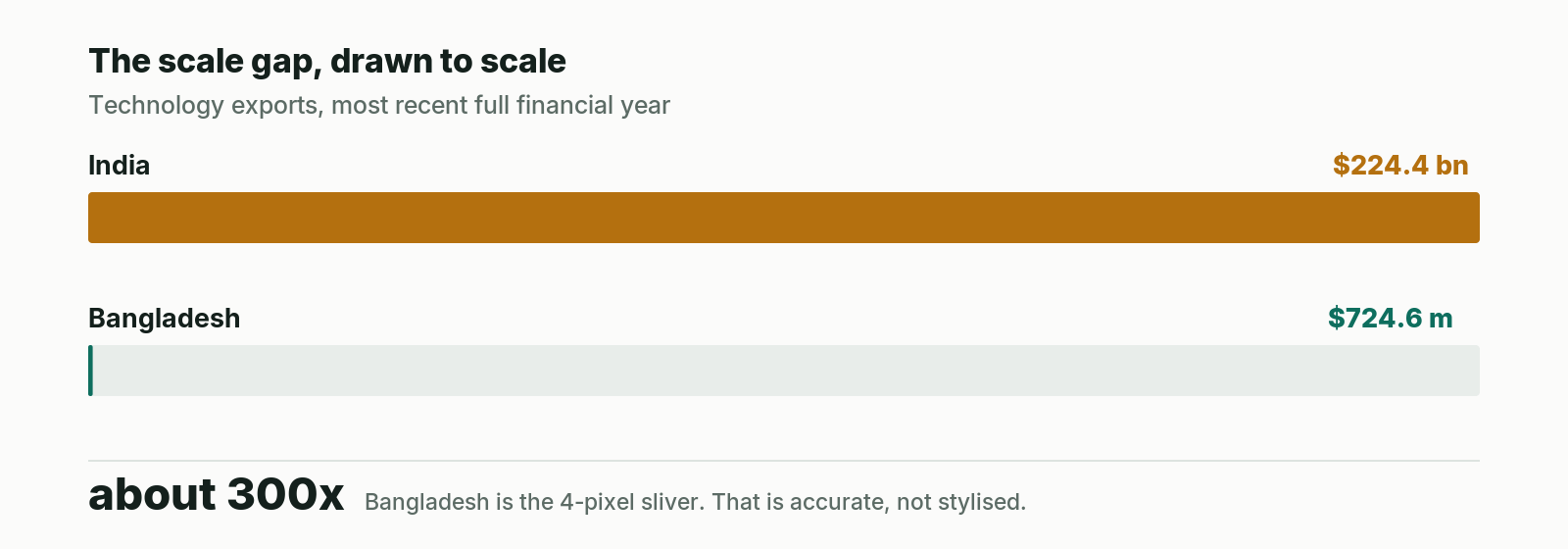
That number deserves to sit there without softening. India's technology sector employs around 5.8 million people (NASSCOM, Strategic Review 2025). Bangladesh's ICT division set a $5 billion export target for 2025 and finished the year at under a sixth of it. The consequences for a buyer are concrete —
- Depth of bench. For rare stacks, or for very large teams assembled quickly, Bangladesh often cannot staff what India can.
- Process certification and enterprise procurement. There are far more CMMI and ISO-certified firms in India, with far more experience of the paperwork that large enterprise buying requires. If your procurement process has a certification checklist, that checklist will favour India.
- English at population level, which has its own section immediately below because it is the one most often misrepresented.
How good is English in Bangladesh, really?
Worse than in India, at national level, and the marketing in our own category tends to claim otherwise. The EF English Proficiency Index 2025 places Bangladesh 71st with a score of 48.11, which sits in EF's "very low" band, against India 34th at 55.49.

Now, the honest counter, and it is a narrow one. That is a population statistic and you are not hiring a population. A firm of a hundred engineers hires selectively, and any vendor worth considering will put you on a call with the actual engineers before you sign anything. That is the whole of our answer. If a Bangladeshi firm tells you English is a national strength here, they are either not looking at the data or they are hoping you will not.
The practical version of this for a buyer: ask for an unscripted technical call with the two people who would actually do the work, not the account manager, and judge from that. It is a fifteen-minute test and it beats every claim on every vendor website, ours included.
What is the difference between staff augmentation and outsourcing?
In staff augmentation you hire engineers who join your team and report into your process, and you keep ownership of the planning, the priorities and the architecture. In outsourcing you hand over a defined scope and the vendor owns delivery of it, which means you are buying an outcome rather than capacity.
The distinction matters most when something goes wrong. Under augmentation, a problem is yours to diagnose and the engineers are there to help you fix it. Under project outsourcing, a problem is contractually the vendor's, which sounds better and is often worse, because you now depend entirely on their willingness and their remaining interest in your account. We have written about that trade-off at more length in staff augmentation vs outsourcing.
How do I choose a vendor after a bad experience?
By asking the questions the last vendor would have failed, which are almost never technical ones. When we analysed 3,120 pages of published content from firms competing in this category, only 48 of them (1.5%) dealt with risk, failure, or what happens when an engagement goes wrong.
Well, that gap is not an accident. It is uncomfortable material to publish, so almost nobody publishes it, and the buyer who has already been burned once is left reading the same optimistic capability decks that sold them the last engagement.
If you are in that position, here is the shortlist we would use ourselves —
- "Who exactly will be on this account, and what else are they on?" Ask for names and current allocation. Vagueness here is the single most reliable early warning.
- "How long has the team on your longest-running account been on it?" One number, easily given if it is good, and instantly revealing if it is not.
- "Walk me through the last engagement that ended badly." Every firm of any age has one. A vendor who claims otherwise is either very new or not being straight with you.
- "What do I physically receive if we stop tomorrow?" Covered in its own section below.
- "Can I speak to the engineers without an account manager on the call?"
None of these are about Bangladesh or India. There is a longer version of that shortlist, with what each answer actually tells you, in how to choose an MVP development agency. They are about whether the firm in front of you will still be looking after you in year three, which is the actual thing you are buying.
Who will still be on my account in three years?
This is the question we think matters most and the one almost nobody asks in a first call. Most of our senior engineers have been with us for more than five years, and on our longest-running client platforms the engineers maintaining them today are the ones who built them.
We are deliberately not giving you a retention percentage. A percentage invites an argument about the denominator, the window and who gets counted, and you have no way to check any of it. What you can do instead is put the same question to every vendor on your shortlist and compare the answers, because the firms who cannot answer it will tell you so by how long they take.
Most engagements of this kind do not fail at the start. They fail somewhere in year two, when the people who understood why the system was built that way have moved on, nobody wrote it down, and the first sign you get is a release that slips for reasons no one can quite explain. That is the failure mode worth underwriting, and it is not visible in any rate card. We have written about the specific ways an augmented team comes apart in staff augmentation risks.
Well, here is the uncomfortable part for our side of the argument. Continuity is the one thing on this page we cannot prove to you with a citation. Every other claim here names a source you can go and check. This one is us telling you about ourselves, which is worth exactly what it sounds like. So please do not take it on trust from us or from anybody else. Ask for the names, ask what else those people are working on, and ask to speak to them before you sign.
What happens to my code if the engagement ends?
You should receive everything, and it should be written into the contract rather than promised in an email. Ours commits us to handing over three things when an engagement ends: the source code, the credentials, and the process documentation.
That sounds like a low bar. It is a low bar, and the reason it is worth stating is that it is not universal: knowledge that lives only in a vendor's heads, credentials held in a vendor's password manager, and undocumented deployment steps are all extremely common, and each one is a quiet dependency that only becomes visible on the day you try to leave.
Notice the difference between the two answers you might get here. "Of course, we always hand everything over" is a statement of intent, and intent is worth very little from a vendor who has stopped being paid. A clause is worth something. So please put the question to every firm on your shortlist, ours included, and ask to see where it is written.
We put the full version of this test in our software project handover checklist: deploy without us, restore without us, revoke our access.
Which should you choose?
- Staffing 50+ engineers on a common stack → India
- Dependent on high-bandwidth spoken English across a large team → India
- Working through enterprise procurement with a certification checklist → India
- Building on a rare or specialised stack that needs a deep bench → India
- A mid-sized company that wants senior attention and continuity → Bangladesh
- Cost-constrained but unwilling to trade away seniority → Bangladesh
- Rebuilding after an engagement went wrong → Neither, yet. Fix the questions you ask before you change the country you ask them in
The last row is the one we would underline. If the previous engagement failed, the country was almost certainly not the reason.
Is there a meaningful time-zone difference?
No. Bangladesh is UTC+6 and India is UTC+5:30, a difference of 30 minutes.
We mention it only because both countries' vendors occasionally present time-zone overlap as a differentiator against the other, and it is not one. Against a US or UK client both countries face the same overlap problem and solve it the same way, with a deliberately overlapping window and written handoffs. Anyone selling you half an hour is selling.
Is outsourcing a dying concept?
No, but the version that was mostly about hourly-rate arbitrage is fading, and AI is accelerating that. Bangladesh's own IT exports grew 13.5% in the first five months of FY2025-26, which the Export Promotion Bureau and BASIS both attribute in part to AI-driven demand.
What has changed is what buyers are actually purchasing. Ten years ago the pitch was "the same work for less". Today the work that survives being sent abroad is the work that needs judgement: architecture, systems that have to keep running, integration into messy existing estates. That work is bought on trust and continuity, which is precisely why the questions in this article are about who stays rather than what things cost.
Where this leaves you
If you take one thing from this piece, please let it be that the country is the smaller half of the decision. The difference between a good vendor and a bad one inside either country is far larger than the average difference between the two countries, and every question on this page works equally well in Dhaka, Bangalore, Warsaw or Manila.
We are a Bangladeshi firm and we have told you where India is the better choice, because we would rather you made the right decision slowly than the wrong one quickly with us. If the shape of your problem is the one in the Bangladesh rows of that table, we would genuinely like to talk. Our dedicated development team page sets out how we actually staff and run one, which is a more useful place to start than a contact form.
I hope this comparison has been to some aid to you. If you think we have got something wrong, or you have a number better sourced than ours, do let me know. Thanks!
---
Sources
- English proficiency: EF English Proficiency Index 2025 (Bangladesh 71st, 48.11; India 34th, 55.49)
- India technology sector: NASSCOM, Technology Sector in India: Strategic Review 2025 (employment ~5.8 million)
- Bangladesh ICT exports: Export Promotion Bureau, FY2024-25 ($724.6M, +7.7% YoY)
- GNI per capita: World Bank, GNI per capita, Atlas method (current US$), 2024 (Bangladesh $2,820; India $2,550)
- Indian IT attrition: Analytics India Magazine, FY2022-23 quarterly roundup (TCS 21.5%, HCLTech 23.8%, Mindtree 24.1%, industry average ~24% per AIM); the ~13% FY2025 figure is ARITS's own compilation from TCS, Infosys, Wipro and HCLTech's most recent quarterly attrition disclosures
- Competitor content analysis: ARITS primary research, August 2026 (48 of 3,120 pages risk-shaped) — our own unpublished analysis, no external link