.avif)

Staff augmentation vs outsourcing: which fits your project
Staff augmentation or outsourcing? How each model works, what each costs you in management time, and when to pick which. From the engineers at ARITS.
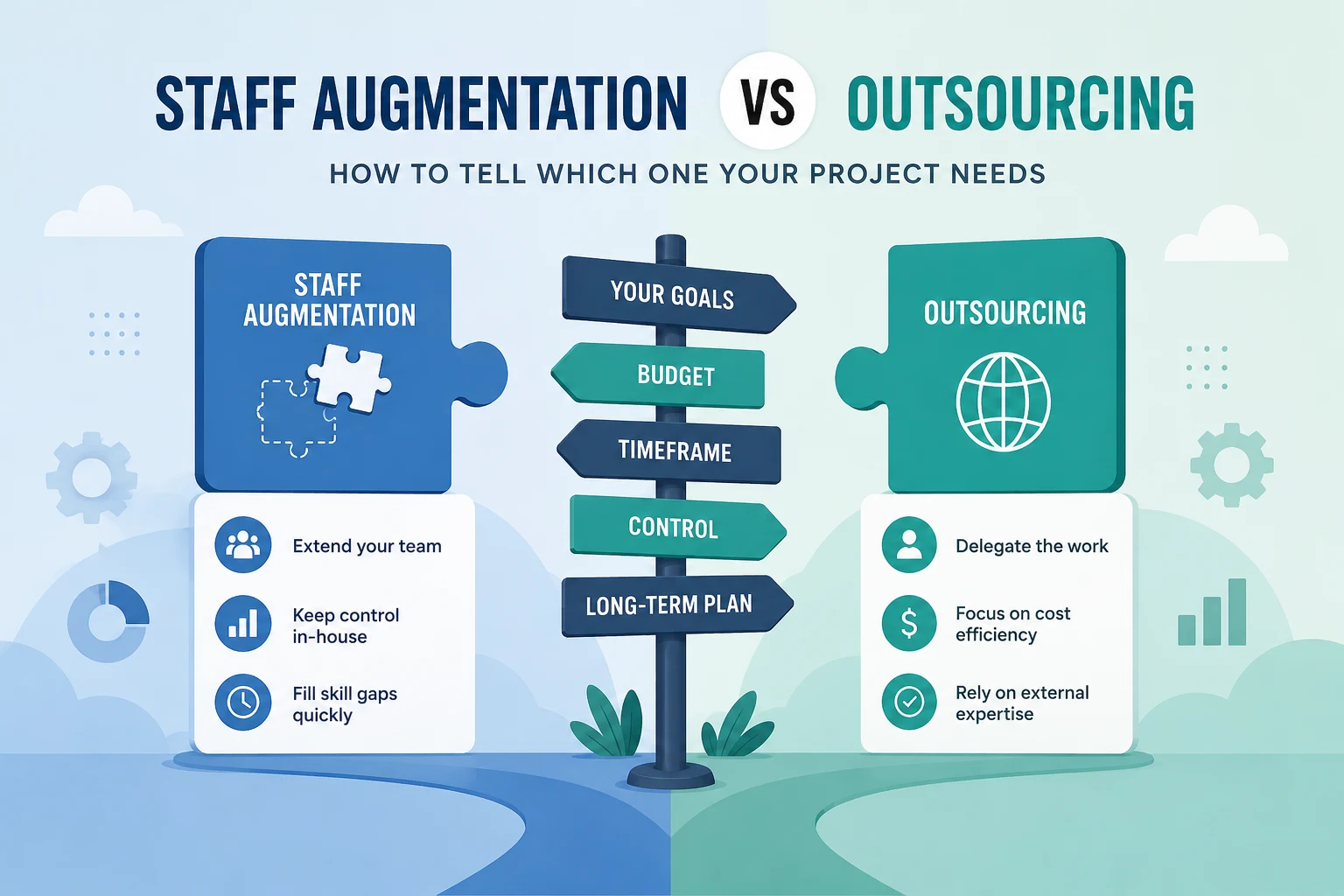
Staff augmentation means you bring in outside engineers who work inside your team, on your tools and your process, under your direction. Outsourcing means you hand a defined piece of work to an outside team that owns the delivery and gives you back a finished result. Both put more capacity behind your roadmap. They ask very different things of you in return.
TL;DR: The deciding factor is rarely price: it's how much of your own time you can spend directing the work. If you have that management capacity and a roadmap that's still moving, staff augmentation flexes with you, because you supply the direction and just need more senior engineers inside your own process. If you have a clear spec and want it off your plate, outsourcing does the job instead, because you're handing a defined problem to a team that owns the outcome and manages itself.
The quick way to decide: pick staff augmentation when you have the people to manage the work and you just need more skilled hands. Pick outsourcing when you'd rather hand off a whole problem and hold one partner accountable for the outcome. Most of the confusion we see comes from picking one model while secretly wanting the other.
What staff augmentation actually is
You stay in charge. The engineers you add join your standups, pull from your backlog, commit to your repos, and answer to your tech lead. They are extra capacity that thinks and works like part of your team, often for a few months, sometimes for a year or more.
If you want the mechanics of that arrangement once someone actually joins, we cover how team augmentation works day to day in a separate post.
This works beautifully when the bottleneck is people, not direction. Say you know exactly what you're building and how, but you're three engineers short and hiring full-time would take a quarter you don't have. Augmentation closes that gap in a week or two instead. You keep ownership of the architecture, the priorities, and the codebase. You also keep the management load, because those engineers need the same context, code review, and unblocking that any team member does.
The quality of the individual engineers matters more here than in any other model. A weak augmented developer doesn't fail quietly. They show up in your sprint, in your pull requests, and in the rework your own team has to do. This is why we put senior people into augmentation roles, engineers who can reason about your system rather than just close tickets. You are renting judgement, not headcount. There's more on staff augmentation in an earlier piece if you want to go deeper.
What outsourcing actually is
You hand over a scope. The partner takes a defined problem, owns how it gets built, manages their own people, and delivers a working result against an agreed spec. Your involvement shifts from daily management to setting direction, reviewing milestones, and signing off.
Outsourcing earns its keep when the work is well-defined and reasonably self-contained. A new mobile app, a payments integration, a data pipeline, a platform migration. You describe the outcome and the constraints, and a team that has built that kind of thing before runs it end to end. You trade some day-to-day control for not having to think about it every morning.
The risk lives in the spec and the seams. Anything you didn't describe clearly is a guess someone else makes for you, and the place where outsourced work most often goes sideways is the handoff back into your own systems and team. Good outsourcing partners design for that handoff from the start, with clean architecture, real documentation, and a codebase your engineers can actually take over.
The real question: how much management can you spend?
| Staff augmentation | Outsourcing | |
|---|---|---|
| Who directs the work day to day | You do, through your own tech lead and process | The delivery partner does, against the agreed spec |
| Who owns the delivered outcome | You do, the engineers execute inside your ownership | The partner does, until it hands over a finished result |
| What the contract is shaped around | Time and capacity: people, skills, duration | A defined scope and deliverable |
| What you are paying for | Senior judgement working inside your process | A finished result, built and managed end to end |
| Management time you spend | Ongoing: onboarding, review, unblocking | Periodic: setting direction, milestone review, sign-off |
| How it ends | Engineers roll off when the work does. The codebase was always yours. | The partner hands the finished result into your systems and team. |
The honest deciding factor is rarely cost per hour. It's your own capacity to direct the work.
Augmentation gives you maximum control and flexibility, and it asks for management attention in return. If your team is already stretched thin and nobody has the bandwidth to onboard, review, and unblock new engineers, augmentation can quietly stall. You added hands but not the time to point them.
Outsourcing frees your attention and asks for a clear scope and a bit of trust in return. If you can't yet describe what "done" looks like, or the work is tangled through every part of your product, outsourcing tends to produce something technically finished that still misses what you meant.
So ask yourself two things. Do I know precisely what I want built? And do I have the people to manage builders day to day? Two yeses, and either model works, so pick on flexibility. A clear scope but no management capacity points to outsourcing. Management capacity but evolving requirements points to augmentation.
Where cost actually comes from
Cheaper-by-the-hour is the wrong lens. The expensive outcomes are the silent ones: an augmented team you couldn't manage, or outsourced work you have to rebuild because the architecture underneath it won't hold.
We don't compete on being the lowest rate, and we'll say so plainly. What you're paying for in either model is senior engineers who make sound architectural calls early, so the thing they build still stands up when you scale it, hand it off, or come back to change it a year later. That's where the real money is saved, and it doesn't show up on an hourly invoice.
Staff augmentation vs dedicated team: what changes?
What changes is the team's shape and who manages it day to day. Staff augmentation adds individual engineers straight into your existing team, under your own tech lead, so you manage each one the way you'd manage any hire. A dedicated development team is a stable group that ARITS staffs and manages as a unit, working against your roadmap but reporting through us rather than through your own management chain. Either way, the roadmap and the codebase stay yours. Choose augmentation when you want engineers folded directly into a team you already run. Choose a dedicated team when you want a consistent unit you can direct without managing each person inside it. Our dedicated development team page sets out how we run one.
Is staff augmentation the same as time and materials?
No. Time and materials is a billing method: you pay for the hours worked, with no fixed price set for the whole job. Staff augmentation is an engagement model: it describes how the people are organised and managed, not how they're billed. Most augmentation happens to be billed time and materials, because the scope shifts as your roadmap does, so the two get lumped together as if they were one thing. But an outsourced project can also run against milestones rather than a fixed price, and an augmented engineer can sit on a retainer instead of being paid by the hour. The billing method never tells you who directs the work. That's the question that actually decides whether augmentation or outsourcing fits your situation.
Staff augmentation vs contractors: what is different?
The difference is accountability, not skill. An independent contractor is usually one person you hire directly, who sets their own hours and tools and often shapes their own scope, and who answers to their own business rather than yours. An augmented engineer works inside your process, your standups, your backlog and your tech lead, much like an employee would, but comes to you through a firm that recruits, vets and can replace them if the fit is wrong. That firm also carries the continuity: if one engineer leaves, the arrangement doesn't collapse with them, because the firm supplies the replacement and runs the handover. A single contractor suits a short, well-bounded task. Augmentation suits work where you need that person to behave like part of your team for months at a time.
Staff augmentation vs a statement of work
A statement of work describes an outsourced engagement, not a staff augmentation one, and mixing the two up is where a lot of disappointment starts. A statement of work fixes the scope and the deliverables before work begins, which only makes sense when you can describe the outcome in advance. Staff augmentation doesn't work that way, because the whole point is capacity that flexes with a roadmap you're still shaping. Ask an augmentation engagement for a fixed deliverable list like a statement of work and you'll get vague milestones nobody can hold anyone to. Ask an outsourced build to run without one and you'll get scope drift with nothing to point back to. If you find yourself trying to write a statement of work for engineers who report into your own team, that usually means you wanted outsourcing after all.
Is team extension just another name for staff augmentation?
Yes, in almost every case. Team extension and staff augmentation describe the same arrangement: outside engineers who join your team, work under your direction, and add to the capacity you already have rather than taking over a piece of work. Some firms use team extension because it sounds less transactional, and some use it to mean a slightly longer, more embedded engagement, but there's no accepted line that separates the two in practice. If a vendor draws a sharp distinction between them, ask what specifically changes about direction, ownership or contract shape. If the answer is nothing, you're looking at the same model with a different label.
How we approach it at ARITS
Over the past decade we've run both models across banking, retail, health, and public-sector work, on more than 400 projects. We've added senior engineers into client teams as direct extensions, which is how we run staff augmentation, and we've taken whole builds off clients' plates end to end. A fair number of engagements start as one and become a blend, which is usually a healthy sign that we got close enough to your work to be trusted with more of it.
What stays constant either way is the architecture-first habit and senior people doing the thinking. Whether an engineer sits inside your standup or inside ours, the code is built to be owned, read, and changed by whoever holds it next.
Between staff augmentation and project outsourcing sits a middle path: a dedicated development team that stays stable and focused on your roadmap rather than shifting project to project.
If you want to see what a clean exit looks like before you need one, we published the software project handover checklist we run on our own projects.
If you're weighing the two for something specific, the fastest way through is a short call. Tell us the problem and your team's shape, and we'll tell you straight which model fits, even when the answer is the smaller engagement.
Frequently asked questions
What is the difference between staff augmentation and outsourcing?
Staff augmentation adds outside engineers who work inside your team, under your direction, on your process and tools. Outsourcing hands a defined scope to an outside team that owns the delivery and returns a finished result. Augmentation keeps you in control and asks for management time; outsourcing frees your time and asks for a clear scope.
When should I use staff augmentation instead of outsourcing?
Use staff augmentation when you already know what you're building and how, the only gap is skilled people, and you have the capacity to manage them day to day. It's the faster way to add senior engineers without waiting out a full hiring cycle, while keeping ownership of your architecture and priorities.
Is staff augmentation cheaper than outsourcing?
Not reliably, and hourly rate is the wrong thing to optimise. The costly outcomes are an augmented team you don't have time to manage, or outsourced work you have to rebuild because the architecture won't hold. Both models cost the most when the engineers aren't senior enough to make sound calls early.
Can a project use both staff augmentation and outsourcing?
Yes, and many do. A common path is to outsource a well-defined build, then keep one or two of those engineers on as augmentation to support and extend it once it's live. The key is a clean architecture and real handoff so your team can own the result either way.
How quickly can augmented engineers start?
Usually within one to two weeks. After a short call to understand your stack, your process, and the gap you're filling, we line up engineers who can reason about your system and get them into your workflow with minimal ramp-up.