.avif)

Software Development Team Augmentation: How It Works
What software development team augmentation looks like once engineers join your codebase: who manages them, access, ownership, and a clean exit.
Software development team augmentation means adding engineers from an outside firm to a team you already run, under your management, in your codebase, and inside your process, rather than handing a piece of work to a separate delivery team. The engineers join your standups, work your board, and follow your process, managed by default by your own lead, with an optional delivery manager on our side to coordinate. You keep the roadmap, and architecture decisions are yours to keep in-house or hand to one of ARITS's senior solution architects working inside the team.
This is for a technical or product leader who has already decided to add outside engineers to an existing team and wants to know how team augmentation works once someone joins: who manages the new engineer day to day, what access they get, how quickly they become useful, and what happens to the work and the knowledge when the engagement ends.
What team augmentation means once someone joins your team
Once someone joins, team augmentation stops being a staffing decision and becomes a management one. The augmented engineer works inside your existing structure by default, though some engagements add a delivery manager on our side to coordinate, and their work is judged by the same standards as everyone else's on the team: your code review, your definition of done, your sprint cadence.
The key distinction in team augmentation is that the augmented engineer follows your direction, not a vendor's. The engineer is senior enough to need little supervision on the mechanics of the work, but the direction of the work is still yours to set. Nobody on the augmented side should be deciding what gets built next.
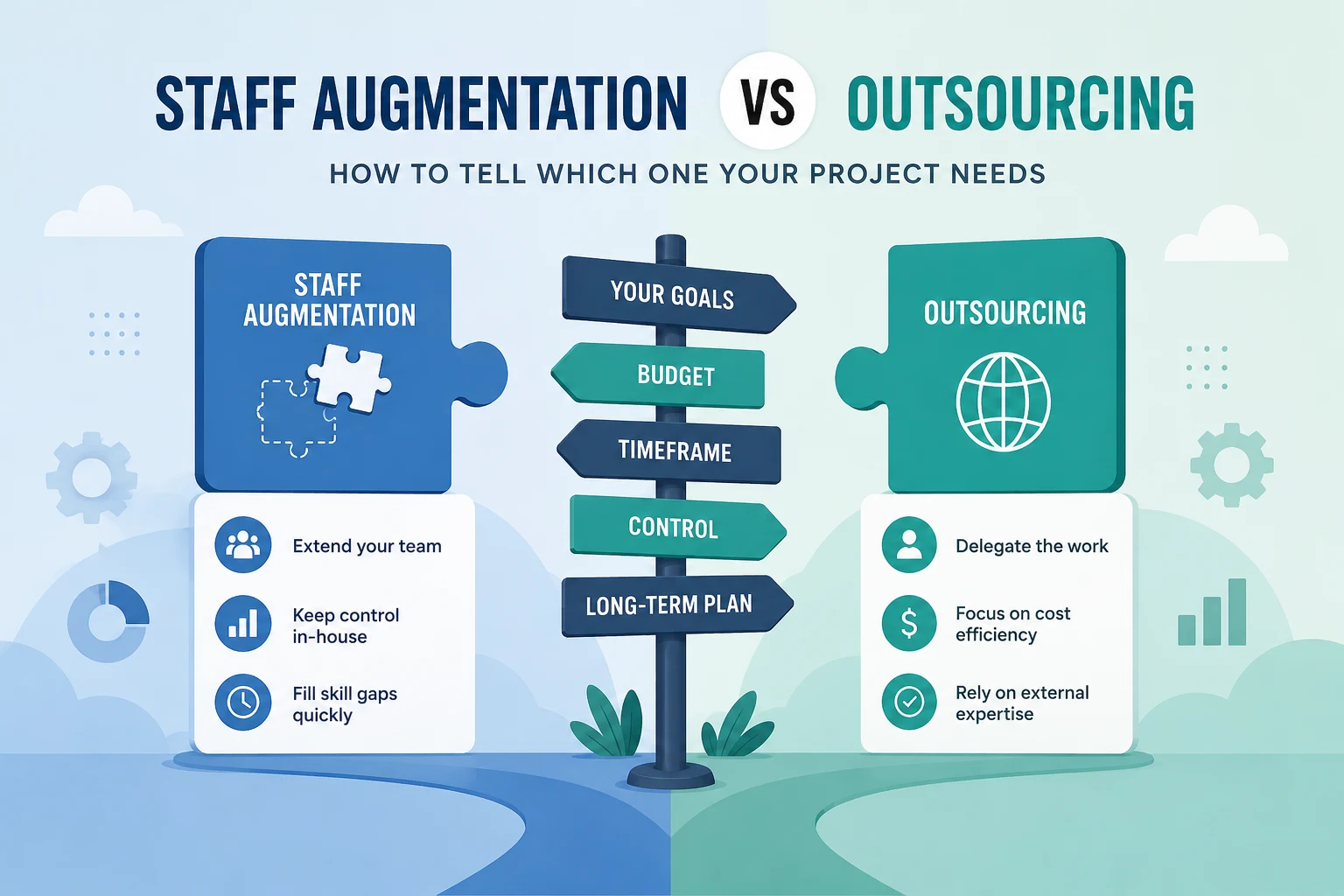
If you are still choosing between models rather than setting one up, the comparison lives in staff augmentation vs outsourcing. The short version: an augmented engineer works inside your team against your roadmap, while a dedicated development team runs its own roadmap against goals you set. The two differ mainly in who owns the roadmap, not in seniority or the quality of the engineers.
Who manages an augmented engineer?
Who manages an augmented engineer is your choice: some clients have their own lead manage the engineer directly, and others prefer a delivery manager from ARITS to coordinate the engagement. ARITS runs both setups, and neither one changes where the engineer's code and process live.
In the direct setup, your own engineering lead manages the augmented engineer the same as anyone else on the team. Standups, ticket assignment, and code review all run through your existing structure, with nobody from ARITS in between.
In the delivery-manager setup, ARITS provides a project or delivery manager who tracks progress, coordinates with the augmented engineer, and flags problems early. The engineer still works inside your process and your codebase, taking direction from your team on what to build. The delivery manager coordinates the engagement; they do not manage the work itself.
How quickly does an augmented engineer become useful?
An augmented engineer can usually start sooner than a permanent hire, because there is no recruitment cycle in front of them, but becoming useful still takes longer than a staffing pitch usually implies. The speed comes from seniority, not from skipping onboarding: someone who has shipped production code for years does not need to be taught how to write a pull request, only how your system is put together.
What actually sets the pace is how well your architecture and decisions are written down, and whether someone in-house has time to pair in the first days rather than hand over a document and disappear. Where that groundwork exists, an augmented engineer can pick up real tickets inside the first week or two. Where it does not, expect the first weeks to go into building that groundwork.
What access do they get, and what stays yours?
An augmented engineer gets the access needed to do the work and nothing more: the repository, the ticket system, the environments they need to test against, and the tools your own engineers use. Code ownership, the roadmap, and the intellectual property in what gets built all stay with you.
Our agreements assign the code and the intellectual property to you. We ask for access, never for a copy. There is no separate repository on our side that mirrors yours, and no staging environment we run that your own team cannot see into. If an engagement ends, revoking a role in your systems is what closing it out looks like.
How architecture stays coherent when outside engineers join mid-project
Architecture stays coherent when it is owned in writing before a new engineer's first ticket, whether that ownership sits in-house or with an ARITS architect on the team, so the augmented engineer reads decisions instead of inferring them from the code. We treat this as the first step of onboarding, not an afterthought: before writing anything, a new engineer is walked through why the system is shaped the way it is, not just what it currently does.
The risk without that step is not incompetence, it is drift. An engineer working against a deadline optimises for the ticket in front of them, which is correct behaviour on their part and exactly why architecture cannot be left to be picked up along the way. We have written about what erodes this discipline over time, and what to settle before it does, in staff augmentation risks.
Where we can, we pair the new engineer with whoever owns the architecture, whether that is someone in-house or an ARITS senior solution architect on the team, on the first pieces of real work, so the architecture gets applied under supervision rather than guessed at alone. It is a small cost early that avoids a much larger one later.
What happens to the knowledge when the engagement ends?
Whether knowledge survives the end of an augmentation engagement depends on whether it was written down as the work happened. Because code ownership and access sit with you throughout, there is no repository to migrate and no account to transfer. What can be lost instead is context: why a particular service is built the way it is, and what the augmented engineer knew that never made it into a document.
We treat context retention as part of the delivery, not a wrap-up task. Decisions get written where your team already looks, pairing continues through the engagement rather than only at the start, and we ask, periodically, who besides the augmented engineer could safely change each part of the system. If the honest answer is only them, that is a dependency to plan out of before the engagement ends, not after.
The exit itself should be short because there was never much to hand over. If you want the fuller version of what a clean handover holds, whatever the engagement, we have set it out in the software project handover checklist.
What a typical first month looks like
A typical first month runs in four stages, and none of them should surprise you, assuming the architecture is documented and someone in-house has time to pair with the new engineer. This is a general shape, not a guarantee, since the pace always depends on how ready the codebase and the documentation are.
- Week one: access is granted, the engineer is walked through the architecture and the decisions behind it, and they are paired with someone in-house on a small, low-risk ticket.
- Week two: the engineer starts taking on real tickets from the backlog, still reviewed closely, with questions going to the person they are paired with rather than sitting unanswered.
- Week three: review moves closer to how the rest of the team is reviewed, and the engineer starts contributing in planning, not only in execution.
- Week four: the engineer is working at the same cadence as the rest of the team, and the first check on context transfer happens: what have they learned that is not written down yet.
By the end of the month you should be able to say plainly whether the arrangement is working, because there has been enough real work to judge it against, not just enough time to have passed.
How we run augmented teams at ARITS
We ask for the architecture to be written down before a new engineer's first ticket, whether the architecture is owned by your team or by one of ARITS's senior solution architects working inside your team, and we ask who has time to pair with the new engineer in the first weeks. If neither exists yet, we would rather help build it than start without it.
Our engineers keep working inside your process for as long as the engagement runs, and we check, on a regular cadence, that knowledge is moving both ways rather than only into the augmented engineer's head. When the work outgrows a few added engineers and starts to look like its own workstream, that is usually the point to talk about a dedicated development team instead.
Frequently asked questions
Is team augmentation the same as staff augmentation?
Team augmentation and staff augmentation usually describe the same model: engineers from an outside firm join your existing team, working as part of it rather than as a separate team. Some firms use "team augmentation" for adding several engineers at once, but ARITS uses the two terms interchangeably.
Do augmented engineers work in my time zone?
ARITS engineers are based in Dhaka, and how much of your day they cover depends on where your team sits. For UK clients, ARITS shifts its engineers' hours to give a solid overlap across the core hours of the UK working day, though not the full day. For US clients, the default is an overnight handoff, with a live overlap window only when one side shifts its working hours to create it.
Who owns the code an augmented engineer writes?
The client owns the code an augmented engineer writes, including the repository and the intellectual property, as set out in the engagement agreement.
How long does a team augmentation engagement usually last?
A team augmentation engagement runs as long as the need does, from a few months to cover a defined piece of work up to a long-running arrangement measured in years. There is no fixed term built into the model itself.
Can it scale down as easily as it scales up?
Team augmentation scales down more easily than permanent hiring, within the notice period in the agreement. Because ownership and access sit with the client from the start, removing an augmented engineer is a staffing change, not a project to unwind.
If you are weighing team augmentation for work that has already started, you can talk it through on our contact page.